
What Is Growth Marketing and How Does It Work?
July 14, 2026 · 3 min read · by qcvimarketing@qcverify.com
Learn what growth marketing is, how it works, and why businesses use data, experimentation, AI, and customer insights to drive sustainable business growth and maximize marketing ROI.
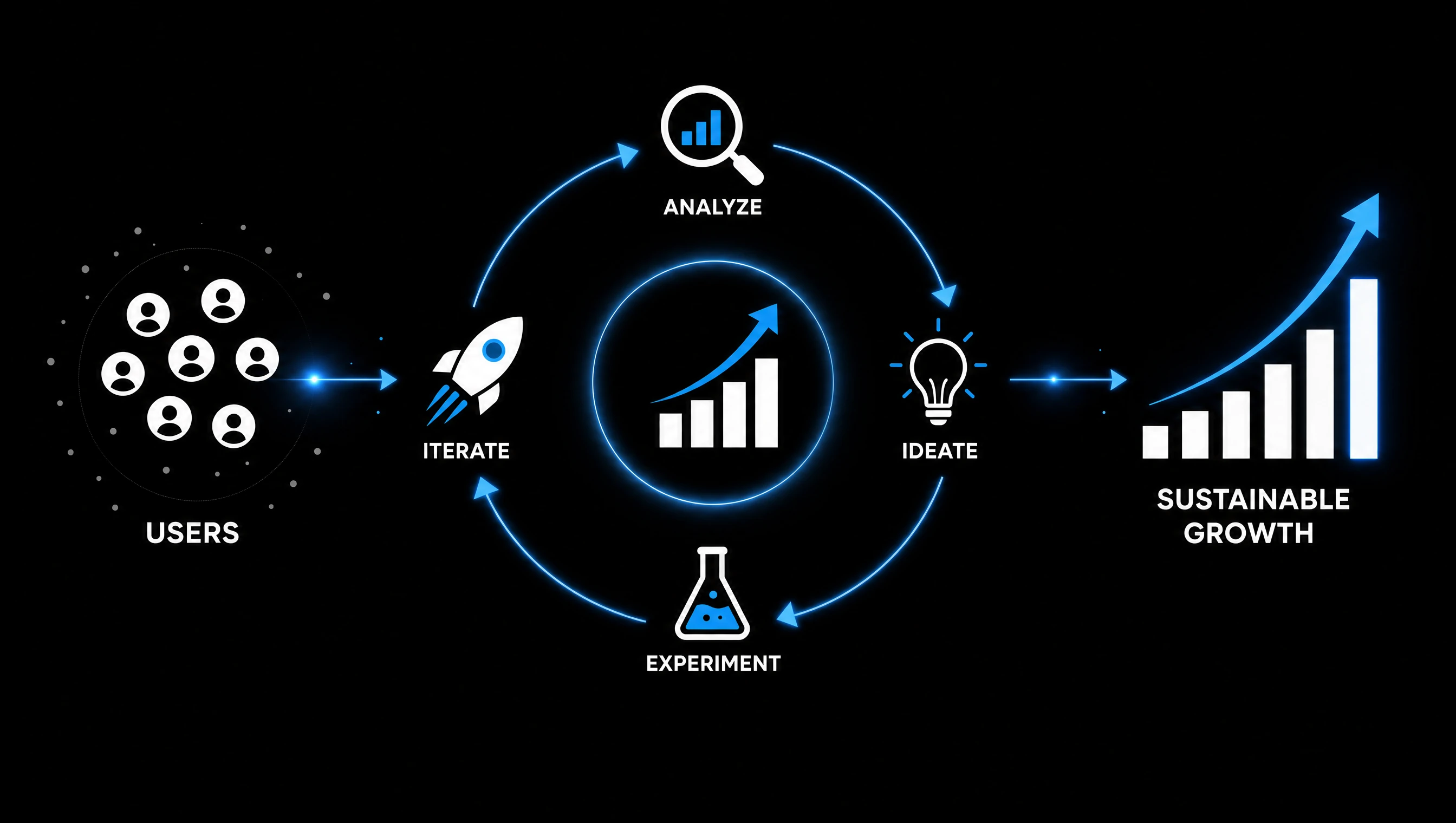
Growth marketing is a data driven approach that helps businesses increase customer acquisition, improve conversions, strengthen customer retention, and drive sustainable revenue growth. Unlike traditional marketing, which focuses mainly on brand awareness, growth marketing optimizes every stage of the customer journey using analytics, testing, automation, and customer insights. By continuously improving performance, businesses can achieve scalable growth and maximize customer lifetime value.
What Is Growth Marketing?
Growth marketing is a data driven marketing approach focused on optimizing every stage of the customer lifecycle to drive sustainable business growth.
Unlike traditional marketing, which often concentrates on generating awareness and leads, growth marketing looks at the entire funnel, including:
- Awareness
- Acquisition
- Activation
- Revenue
- Retention
- Referral
This framework is commonly called the AAARRR Funnel, also known as Pirate Metrics, because it tracks the key stages of the customer journey from awareness to referral.
The objective is simple: identify opportunities, test improvements, measure outcomes, and scale what works.
Growth marketing combines multiple disciplines, including:
- Performance marketing
- Conversion rate optimization (CRO)
- Marketing automation
- Customer analytics
- Email marketing
- Content marketing
- Product-led growth strategies
- Artificial Intelligence (AI)
The result is a systematic process designed to increase revenue while reducing inefficiencies.
How Growth Marketing Differs from Traditional Marketing
Traditional marketing focuses primarily on attracting attention, while growth marketing focuses on improving every stage of the customer journey to increase conversions, retention, and revenue.
How Growth Marketing Works
Growth marketing follows a continuous cycle of testing, learning, and optimization.
Step 1: Analyze Data
Growth marketers begin by collecting and analyzing data from various sources, including:
- Website analytics
- CRM platforms
- Advertising channels
- Customer feedback
- Email performance
- Sales data
The goal is to identify problems, opportunities, and customer behavior patterns.
Step 2: Develop Hypotheses
Based on the data, marketers create hypotheses for improvement.
For example:
- Simplify landing pages to increase conversions.
- Use personalized emails to boost engagement.
- Use AI-powered audience targeting to reduce acquisition costs.
Every strategy starts with a measurable assumption that can be tested.
Step 3: Run Experiments
Growth marketing is built on experimentation.
Common tests include:
- A/B testing landing pages
- Testing ad creatives
- Optimizing email subject lines
- Adjusting website messaging
- Testing call-to-action buttons
The objective is to discover what produces the best results.
Step 4: Measure Results
Every experiment is measured against key performance indicators (KPIs), such as:
- Conversion Rate
- Customer Acquisition Cost (CAC)
- Return on Ad Spend (ROAS)
- Customer Lifetime Value (CLV)
- Revenue Growth
- Retention Rate
This ensures decisions are driven by evidence rather than assumptions.
Step 5: Scale Successful Strategies
When a tactic consistently performs well, businesses allocate more resources to maximize results.
Successful experiments become repeatable growth systems.
Core Components of Growth Marketing
Customer Acquisition
Growth marketing attracts qualified leads through SEO, paid advertising, social media, content marketing, and referral programs. The focus is on driving high-converting traffic.
Conversion Optimization
Growth marketers improve landing pages, user experience, website speed, forms, and calls-to-action to increase conversion rates and generate more revenue.
Customer Retention
Businesses boost customer retention with email automation, personalized experiences, loyalty programs, and customer success strategies. Retained customers increase lifetime value and profitability.
Referral Growth
Referral programs turn satisfied customers into brand advocates, helping businesses generate new leads and scale growth efficiently.
How AI Improves Growth Marketing
AI helps businesses accelerate growth by:
- Predicting customer actions
- Automating routine processes
- Delivering personalized experiences
- Analyzing data quickly
- Improving ad performance
- Enhancing lead qualification
When combined with human expertise, AI supports smarter decisions and reveals new growth opportunities.
Common Growth Marketing Mistakes
Avoid these common growth marketing challenges:
Focusing Only on Acquisition
Sustainable growth requires customer retention and referrals, not just new customer acquisition.
Ignoring Data
Accurate analytics help identify opportunities and improve marketing performance.
Testing Too Many Variables
Run structured tests and change one element at a time for clear, reliable results.
Poor Tracking Systems
Without proper tracking and attribution, businesses miss valuable insights and growth opportunities.
Why Growth Marketing Matters
Consumer expectations continue to evolve, competition continues to increase, and marketing budgets face greater scrutiny.
Rather than relying on isolated campaigns, businesses create a repeatable system for attracting customers, increasing conversions, improving retention, and driving sustainable revenue growth.
Growth marketing provides a structured framework for sustainable business growth. By combining analytics, experimentation, automation, and customer insights, businesses can improve acquisition, increase conversions, strengthen retention, and maximize marketing ROI.
As digital competition continues to grow, organizations that embrace growth marketing are better positioned to adapt, scale efficiently, and achieve long-term success.
Frequently asked questions
What is growth marketing?
How does growth marketing work?
How is growth marketing different from traditional marketing?
Why is growth marketing important?
How does AI improve growth marketing?
Want to discuss something similar for your team?
Book a strategy call