
Ecommerce SEO Guide for Shopify Stores
August 12, 2026 · 3 min read · by qcvimarketing@qcverify.com
Discover how Shopify store owners can improve ecommerce SEO by optimizing product pages, collections, variants, images, inventory, and useful content.
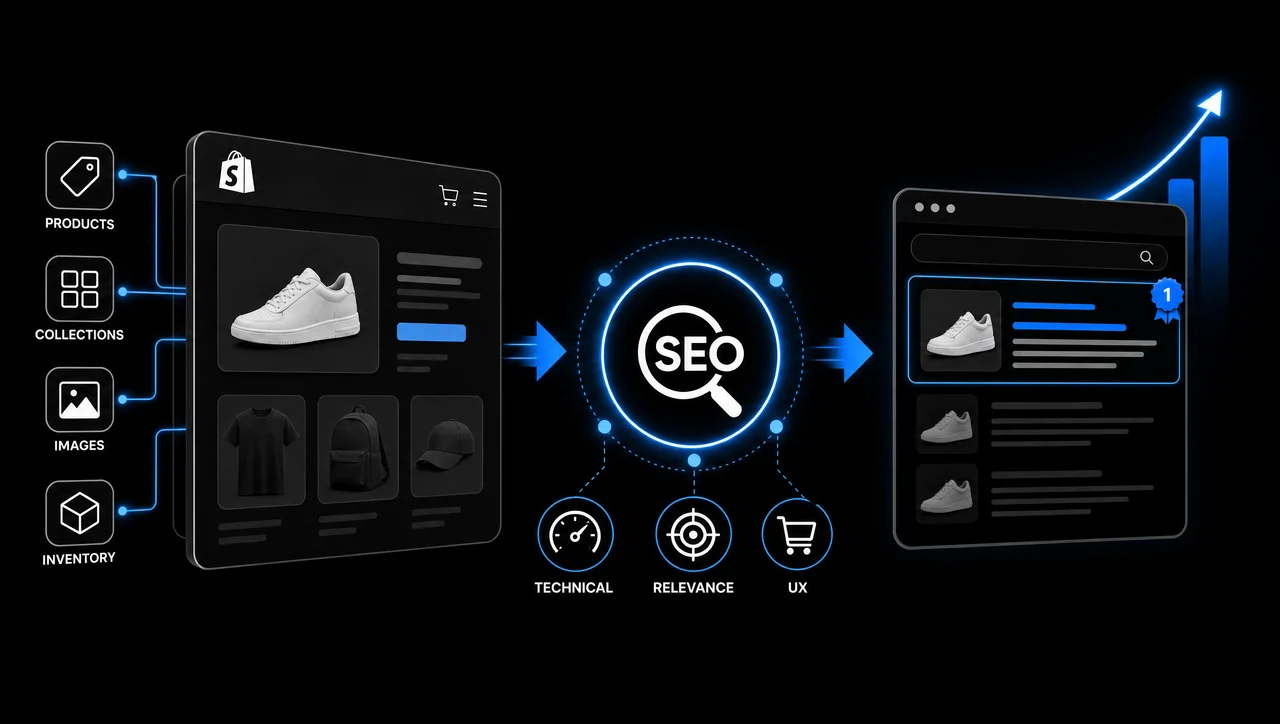
A Shopify store can look great and still struggle to appear in search results. With hundreds of products, different variants, collections, images, and changing inventory, ecommerce SEO requires more than simply adding keywords to a few pages.
For Shopify store owners, the focus should be on making each important product and collection easy to understand, useful to shoppers, and technically accessible to search engines.
Give Every Product Page a Clear Purpose
Your product pages are some of the most important pages on a Shopify store. Product titles, descriptions, URLs, and page headings should clearly explain what is being sold.
Avoid relying entirely on manufacturer descriptions, especially when several stores are selling the same products. Writing original descriptions gives each page more useful information to work with and helps customers understand the product before making a decision.
It is also worth reviewing older products regularly. Pages for discontinued or permanently unavailable products should not simply be forgotten, particularly if they have previously attracted visitors or links.
Pay Attention to Product Variants
Colors, sizes, materials, and other product options can make Shopify stores more complex from an SEO perspective. A store may have several versions of the same product while search engines still need to understand which page represents the main product.
Shopify handles canonical URLs for product pages, which helps identify the preferred version when products can be reached through different URLs.
The important point for store owners is to avoid creating unnecessary pages simply for SEO. A separate page only makes sense when the variation provides genuinely useful information and matches what customers actually search for.
Make Collection Pages Useful
Collection pages are more than a way to group products. They can also help shoppers find what they need and provide search engines with context about a particular product category.
Use clear collection names and descriptions that explain what shoppers will find there. For example, a collection for running shoes can provide useful context about the types of products included rather than relying only on a list of product names.
Good collection structure also makes it easier to connect related products without forcing customers to search through the entire store.
Optimize Product Images
Images are central to ecommerce, but they should not be treated as decoration alone. Use descriptive file names and relevant alt text so the images have useful context.
Large image files can also affect the browsing experience, particularly on mobile devices. Compressing images while maintaining suitable quality can help keep product pages easier to use.
Handle Out of Stock Products Carefully
Inventory changes are unavoidable for ecommerce stores. The SEO impact depends on whether a product is temporarily unavailable, permanently discontinued, or likely to return.
A temporarily unavailable product may still be useful to shoppers, while a discontinued product may require a different approach. Before removing a page, consider whether it still has useful content, search visibility, or links pointing to it.
Use Your Shopify Blog Strategically
Your blog can support product discovery without becoming a collection of generic SEO articles. Focus on topics that naturally relate to what your store sells.
A homeware store could publish guides on choosing products for different rooms, while a clothing store could answer questions about sizing, materials, or styling. These articles can introduce shoppers to products while giving them useful information at the same time.
Final Thoughts
Effective Shopify SEO comes down to paying attention to the details that make an ecommerce store different from a standard website. Product pages, collections, variants, images, inventory, and useful content all deserve a clear SEO approach.
The aim is not to optimize every page simply for search engines. It is to build a Shopify store where customers can find the right products easily and understand what they are buying.
Frequently asked questions
Is Shopify good for ecommerce SEO?
Do product variants affect Shopify SEO?
Should every Shopify product have unique content?
How should Shopify stores handle out-of-stock products?
Want to discuss something similar for your team?
Book a strategy call